

Blog
A Couple of Things
I was going through my blog today pulling some links to some posts, which caused me to re-read most of last year’s entries.
I had almost forgotten how busy last year was. There were just way too many things to accomplish in way too short a time. I’m happy to report that my efforts last August to slow our lives down have been successful. Drew has had a really busy couple of months, but it’s busy in the sane sense, as opposed to the insane pace of last year. I really just can’t do that again, and I’m glad that I know that and can set some boundaries for myself.
In my reading I ran across my post about our business starting to hold even. That put some things in perspective for me, since we’re now making quite a profit off Drew’s business–it pays almost all the bills, so that my writing money only has to supplement it a tiny bit. We have a healthier financial buffer these days, which is nice–especially when everything we own decides to fall apart over the course of a few months. Oh, and our bills have increased just a little since then, what with the whole mortgage and house-sized utilities thing. I really need to stop worrying about money, because while we still have to be really careful, we’re doing fine, and worrying about the future is just borrowing tomorrow’s trouble.
In the next few months, I intend to do some more posts about writing and self-employment, because, you know, that’s what’s going on in my life right now, so that’s what I have thoughts about. There are a bunch of things that I know I’ve said on the internet before, but are not in my archives, which means that I either said them in comments or they are somewhere in the recesses of my livejournal that I’m not going to import. So if you hear some repeats from me, sorry. Most of it should be new stuff, though, because a lot has changed in the last couple of years.
And on a completely random note, we finished Final Fantasy X-2 last night. The game was really bad, but it transformed into awesomeness when we started imagining that these weren’t the actual events, but Rikku’s spontaneous retelling of the game. The dialog is much better when Rikku says “and then shewas all,” or “and then I was all” before each line. We added Rikku’s other thoughts as our very own MST3K. I just wish they’d subtitled the game “Rikku’s Random Adventures,” because that would have made it all worth it. On the bright side, they didn’t really touch the story from X, so nothing was ruined, and we broke the mechanics halfway through the game, and didn’t have to fight another random encounter after that. I’m pretty sure we finished the game at about half the level we were supposed to be.
Big Wall of Plastic
I tried this new outlining thing yesterday. I’ve been less and less satisfied with my old outlining process lately–it’s all well and good to get the plot down, but especially for my more character-centric books, it’s hard to keep track of what every character is supposed to be doing and thinking all the time. I end up leaving out side characters entirely, their motivations pop in and out in early drafts. The same is true of plot threads. Even though I write with an outline, I end up having to go back and re-outline before each revision.
The last re-outline I did involved a piece of paper with arcs drawn all over it in a sort of timeline. That was helpful, but doing these things on paper meant it was hard to move things around in a fluid way. And I haven’t found a computer program with the kind of free-moving elements I want when I’m outlining. I want to be able to draw arrows and write notes in margins, and that’s really more a by-hand kind of thing.
What I really wanted was to use a big wall-sized space. I had this idea of using post-its, but the post-its fall off and flutter away and are generally annoying. Taping them all to the wall was way too much work.
Enter my big wall of plastic. I went to Wal-mart (though any fabric store will do) and bought two yards of clear plastic sheeting, the kind one can use to cover tables. Then I tacked it to my laundry room wall and went at it with dry erase markers. (FYI, I discovered later that wet-erase markers are easier to erase on this surface, but they don’t write as well. Take your pick.)
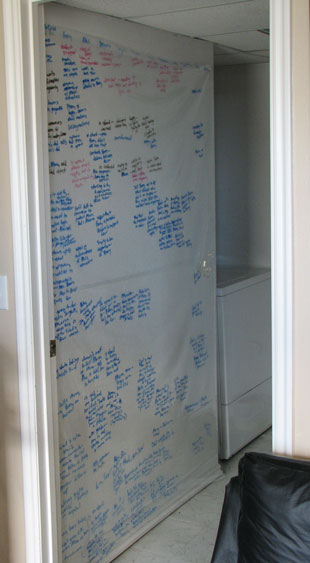
For this outline, I wrote the plot events down the left side of the wall and the characters across the top. For each plot event, I filled in what each of the applicable characters are thinking, feeling, and doing. This way I haven’t forgotten anybody at any stage of the book. I can tell where I’ll need one scene for the actual plot event, containing the reactions and complications of the present characters, and where I’ll need to add additional scenes for the non-present characters to talk and react about what’s going on. I’ve got not just my plot arc outlined, but also a full arc for each character in the book, down to the very minor ones. I changed a lot of things as I went, but I could erase and move elements easily.
Since the wall-outline would by pretty unwieldy for actual writing, I typed it all into a spreadsheet today. I don’t like the spreadsheet for composing, because it’s so hard to look at the whole thing at once, but it’s a nice portable record now that I’ve got it all set.
It took some elbow grease getting the dry erase marker off the plastic (really, next time I’m using wet erase. I’m also going to be more intentional about my color coding–probably one color per character). I’m not sure how this would work for a book with multiple viewpoints. (I don’t write those.) Maybe one color per viewpoint? If anyone tries it, let me know how it goes.
This afternoon I started writing another novel outline up on my wall–one I’ve had outlined and tried to write, but wasn’t developed enough to be a successful first draft. For that one, I’ve written both the characters and the different plot threads along the top of the sheet, so I can keep track of not just the characters, but also the thematic elements. As I fill in the sheet, I can tell when certain characters or elements fall out of the story for chapters at a time, and make decisions about whether or not that’s what I want them to do.
The process helped me find the problem in my second outline: the first four characters are really fleshed out, but the rest of the arcs are all but empty. Guess I have some invention to do on that one. My wall may be staying up for a while, while the ideas percolate.
Cars with Color Accent

Tulip

My tulips are blooming. I took this photo just an hour ago. Now the yard is covered in snow. Ah, Utah spring.

Went shooting in Salt Lake with Drew last weekend. This was the winning shot of the day.
Revision Process
[I may have told this story here before, but it’s on my mind, so I’m going to tell it again, anyway.]
I’m working through a revision right now. It’s the kind of revision where I go through every scene in my book, take it apart, and then put it back together in a better, stronger, more structured way. When I’ve got all the ideas straight in my head, I love this kind of revision. I can’t do very much of it in a sitting because of the way it scrambles my brain. Seriously. This is your brain. This is your brain while revising.
But it makes me think about the way my process has changed. I made this mistake for many years–I was afraid of revising. See, writing a book is so. much. work. I felt like, after I’d done all that work, I ought to have something in front of me that was good. I was convinced that if I just kept writing books, that my skills would improve to the point that I’d be writing books that were good enough. So I wrote seven books.
And here’s what I finally discovered: my first drafts need work. They aren’t very good. In fact, they are always a mess. Which means that after I have done all. that. work. I still need to do a whole lot more work. What I’d done by pushing through book after book was, in effect, give myself five books that were only 25% of the way done. (The first two aren’t worth going back to.) Oh, and I’d already done the part that I knew how to do, and would have to learn all new processes to get the manuscripts the other 75% of the way there.
That realization was slow in coming. I ran away from it for a really long time because I didn’t want to have to admit that the work to write a manuscript was only 25% of the work. I didn’t want to *do* the other 75%. And when I finally bit the bullet and started to really work on honing my revision skills, it was hard and long and there was no end in sight.
These days, I still see finishing a first draft as an accomplishment. But it’s only a 25%-of-the-way-there kind of accomplishment. I don’t get to tell myself I’m done. Not by a long shot. There are still many, many drafts to go. Maybe half the words that are in that first draft are actually going to survive. (Maybe.) So I let it sit for a while, get some feedback from readers, and get to work on that other 75% of the work. My books are much better. I’m happier, because I know I can fix the problems that need to be fixed. And I fix them in the kinds of ground-up ways that make my work stronger. I’m still far from where I want to be, but I’m getting better all the time.
The book I’m working on now has been fully rewritten once, and revised maybe five or six times. But many of those times were the old surface revisions that I used to do, where I was trying desperately to cover up the problems so I wouldn’t have to dismantle the book and restructure it. That’s the one part of the work I’ve found I can ditch–the avoidance. I used to work really hard at avoiding all that work.
WarpPoodles
I’ve been on a mini painting kick lately. I’ve made it a goal to finish up one force per month. In February I finished up the WarpPoodle force. Here’s most of them:
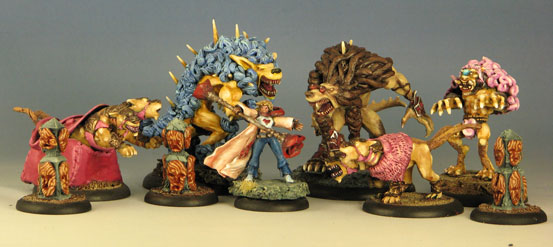
In March I finished up my Cryx–all two models that had been waiting for multiple years to be painted. April’s goal is my Neverborn, but I did 2/3 of them today.
The beauty of the goals is that each force has 2-5 models that need to be done. They’ve just been sitting for a long time, waiting for me to get around to them.

If You Write, You Are a Writer
This is a rant, guys. You are warned.
Lately, I notice a lot of my friends apologizing for being writers. I’ve been noticing this increasing in my presence as I’ve had some success, especially with people I’ve just met, or old friends who weren’t self-identifying as writers when I saw them last.
“I wrote this book,” they’ll say, “but I’m not a really real writer. Not like you.”
The flavor varies. “Yes, I write a blog,” they’ll say, “but I’m not a writer.”
“I only write short stories,” they’ll say. “I’m not a writer.”
“I don’t write every day,” they’ll say. “I haven’t written this week. I’m not published. I’m not really a writer.”
When I press, I often uncover a different story. This friend has finished three novels. This friend attends a weekly writing group. This friend’s blog is quite good. This person is a writer. This person knows they’re a writer. But there’s this meta-think going on where they think that I won’t think they are a writer.
In general, it makes me feel sad to hear people apologizing for who they are. Specifically, it makes me sad to hear writers downplaying their own work. Even more, it upsets me when people use me as a comparison to put themselves down.
I started self-identifying as a writer when I was nineteen years old, finishing my first novel. My writing was not good. It was not published. I was not skilled. But I wrote. That made me a writer.
Not that anyone else took me seriously. Besides my mother. Thank goodness for my mother. When I told her I wanted to be a writer, she told me to go stand in a book store and look at all those people who made it as writers, and ask myself why it shouldn’t be me.
Other people weren’t so confident. I didn’t listen to those other people. For years, every time I told people what I was doing with my life, they scoffed. “So what are you going to do really?,” they’d ask.
Eventually, the scoffing stopped. It stopped around the time I finished my undergrad, and didn’t get a real job and forget about the dream. It stopped around the time I had three novels finished. People stopped scoffing at me, and started looking really confused. I wasn’t fitting the wanna-be writer script anymore. I was something else that people couldn’t quite figure out. I think part of what confused people was my confidence. I had sold exactly nothing. But I was not ashamed to call myself a writer.
Because I was a writer. I had been all along.
Now people I meet get really excited when I tell them about my writing. Sometimes I just want to roll my eyes. Where were these people when I was nineteen? They were scoffing at me, that’s where they were.
But I’m the same writer now that I was then. I’m just farther along in the process.
Others may disagree with me on this, but I think that if you write, you are a writer.
If you write a blog, you may be a blogger, much like I am a novelist. But we’re both still writers.
If you are not published, then you are not a published writer. But you’re still a writer.
If you don’t want to make a living at it, then writing may be a hobby for you. If you can’t yet quit your day job but want to, then writing might be an investment for you. But you’re still a writer.
If you write non-fiction, you are a writer. If you write fiction, you are a writer. If you are *gasp* self-published, you are a writer. If you write *gasp* fanfic, you are a writer. If you write occasionally, you are a writer.
It is okay to be whatever kind of writer you are. But if you write, you are a writer. Please don’t apologize for being who you are.